

News
Latest
People’s Choice 2026
At the RGA’s 95th Annual Exhibition, held at the University of Reading Institute of Education, the University kindly sponsored a People’s Choice Award in celebration of the University’s centenary year.
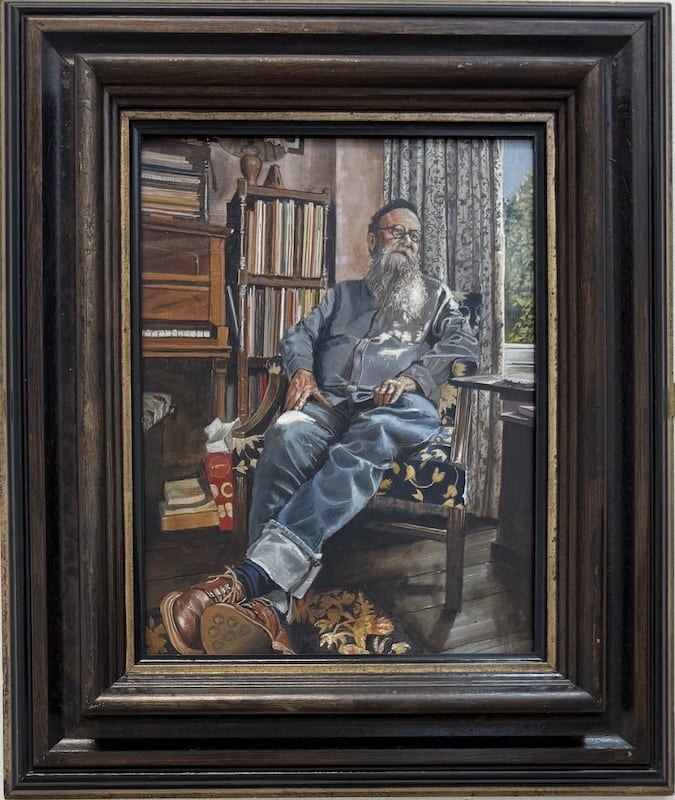
There were over 500 votes and the winner is Martin Andrews for his Portrait of Otto Martin.

Portrait of Otto Martin
Martin Andrews
Oil on panel
45 x 52cmOtto was a lifelong friend of Martin’s and this portrait was painted shortly before he passed away. This is what Martin says about the painting:
“The portrait is of my oldest friend – we met on the first day at Infant school and consoled each other as our mothers left us. Later we shared a school desk and were considered ‘arty’ by our teacher. We grew up in the first garden city of Letchworth which in the 50s and early 60s was still very much a centre of the Arts and Crafts. Otto’s family were all very creative; painters, musicians, jewellers and it was at Otto’s house that I first heard Bob Dylan. The family had a huge impact on me and led to my own passion for the arts and making. We both went to art school, Otto to Bristol and me to Reading, and we became disciples of William Morris.
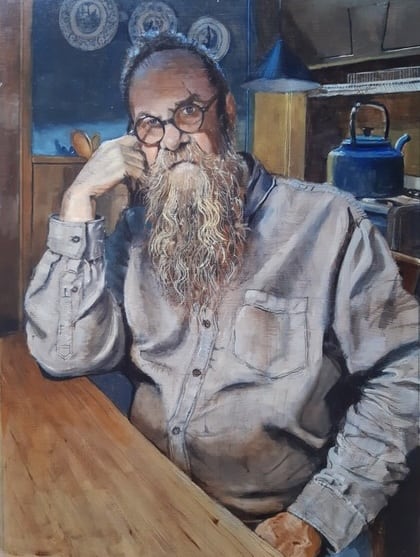
Last year Otto telephoned me to say he had terminal cancer. I visited him in his house in Bristol and we spent a happy and positive day discussing his plans for his funeral. I made some sketches of him and also took photographs to base a portrait on. I painted two portraits – one of him at his kitchen table and the other by the piano – he liked both of them and decided to use the portrait in the kitchen for the cover of the order of service, which I gave him, and I kept one myself. The funeral was amazing full of music and poetry in a beautiful de-consecrated church with hundreds of friends. Otto’s husband has hung the portrait of Otto at the kitchen col on the staircase in his beautiful house which remains perhaps Otto’s greatest work of art. I wanted to exhibit my portrait of Otto by the piano in the RGA summer show in memory of my friend and so I was very moved to be told that the picture had been voted the Peoples’ Choice.”

Martin’s second portrait of Otto Martin’s prize is a voucher for afternoon tea for four people at the University’s beautiful Greenlands campus on the banks of the River Thames at Henley.
Other works which received a high number of votes were: Chris Mercier’s Daphne & Apollo, Lyn Warwick’s Belinda and Michael Norcross’s Autumn Glory.
Pauline Mercier Award 2026
The assessor for the Pauline Mercier Award for 2026 was Dr. Suzy Tutchell, Associate Professor in Art Education at the University of Reading.
Winner
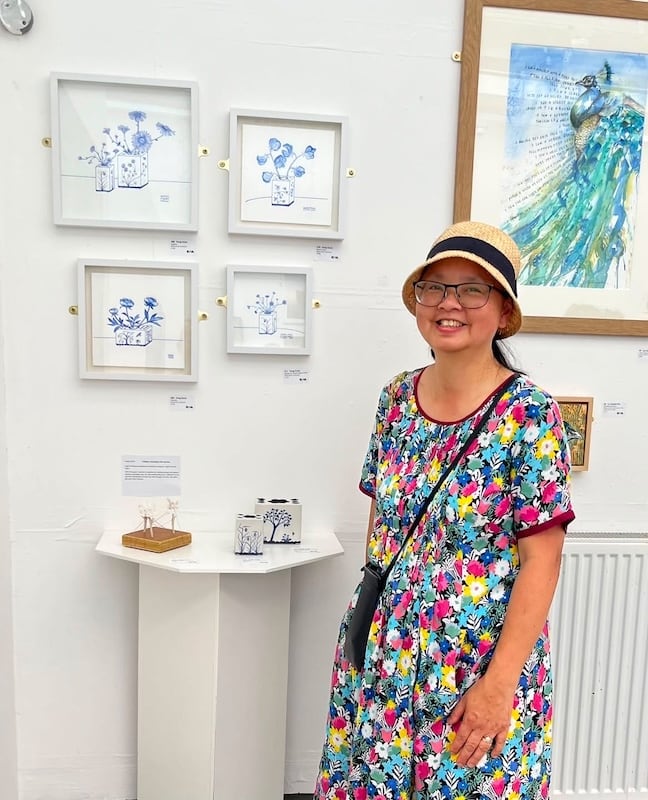
Congratulations to winner of the 2026 Pauline Mercier Award for 3D work, Fong Scott for her piece 3 Daisies, Friendships Old and New.

2026
3 Daisies, Friendships Old and New
porcelain, wood and copper wire
Fong Scott
Assessor: Suzy Tutchell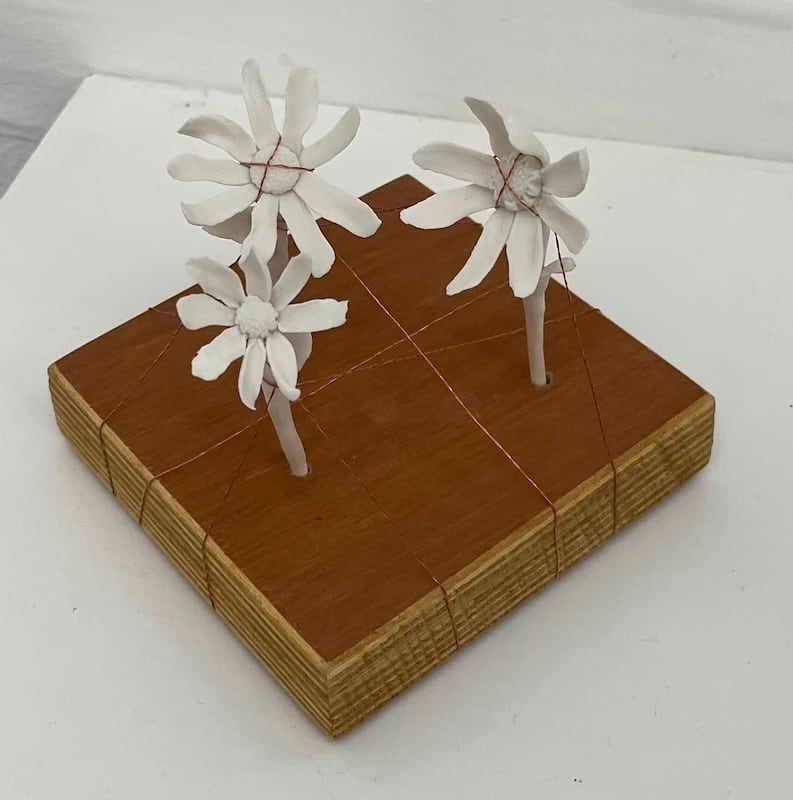
Fong says of this work:
A gift of flowers provokes an emotional response. A gift from the heart. With this piece I wanted to develop my making process and capture daisies in porcelain clay. As I was making this piece I reflect on my journey, friendships old and new have brought me here, we often gift each other flowers.

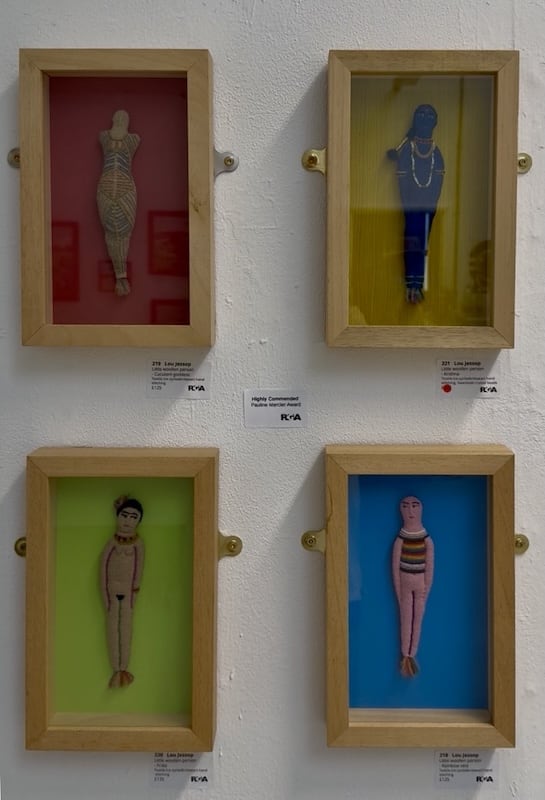
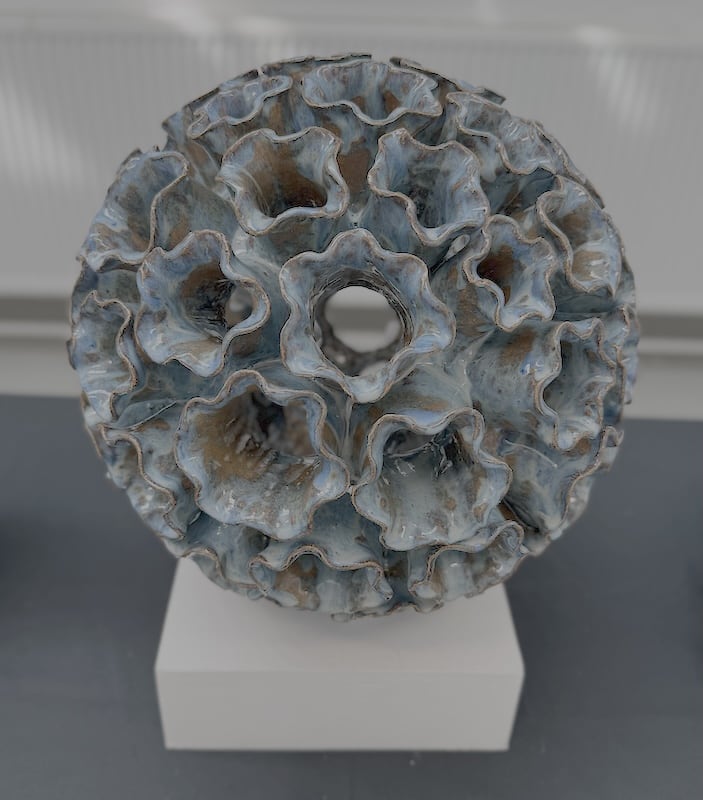
Fong stood next to her work. Highly Commended
Congratulations also to Caroline Gatfield and Lou Jessop who were both Highly Commended.
Marie Dyson Award 2026
The assessor for the Marie Dyson Award for 2026 was Dr. Suzy Tutchell, Associate Professor in Art Education at the University of Reading.
Winner
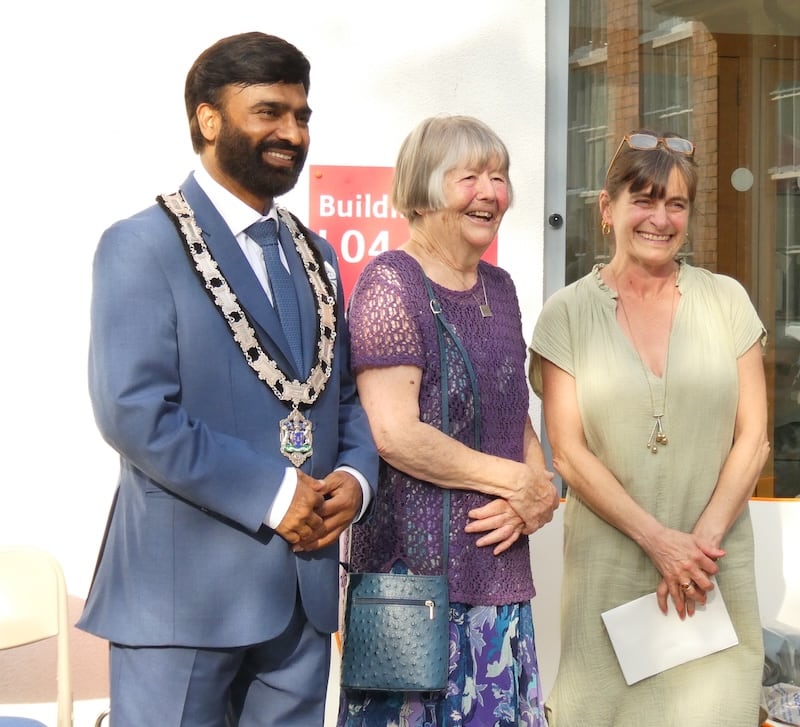
Congratulations to Mary Law who was the winner of the Marie Dyson Award for two dimensional work.
2026
Orange Turban
Acrylic
Mary Law
Assessor: Suzy Tutchell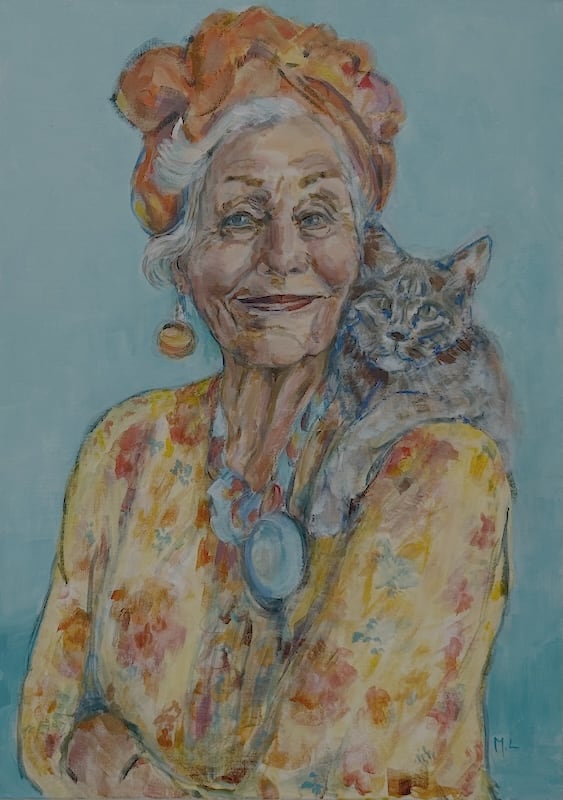

Deputy Mayor, Councillor Amjad Tarar, Marie Dyson winner Mary Law and assessor Suzy Tutchell Highly Commended
Congratulations also to Sri Nambiar and Antoinette Brown for being Highly Commended.
Gathering Storm
Charcoal
Sri Nambiar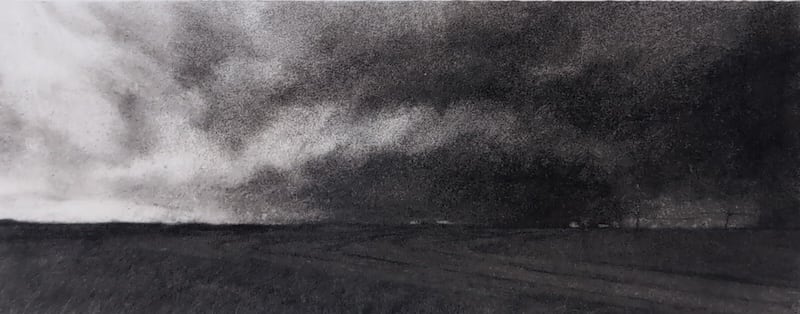
I Stand and Around Me Circles Time
Graphite on paper
Antoinette Brown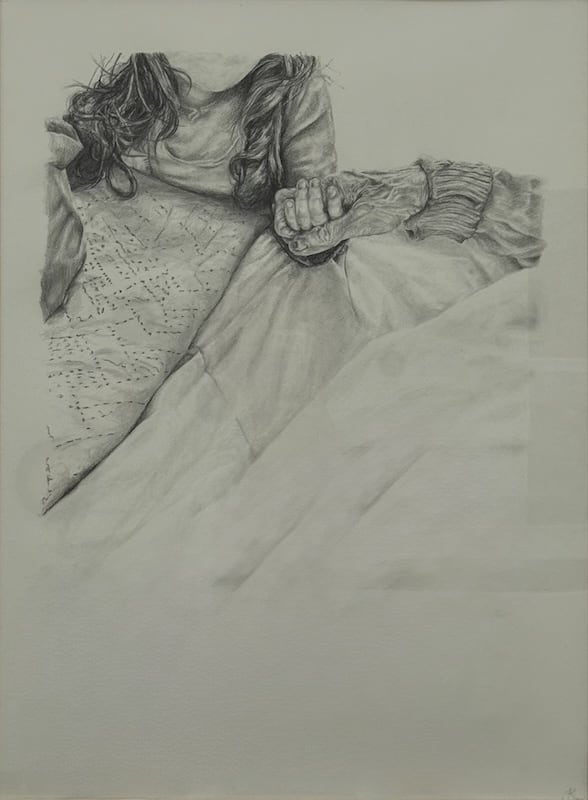
An Unknown Artist
By Martina Hildebrandt
The RGA has very nearly 100 years of history, with thousands of artists, so it is unsurprising that we get enquiries about past members or a painting someone has inherited or bought. Some enquiries are straight-forward where we can provide some biographical details and perhaps trackdown a painting in our catalogues.
But it was on this occasion, when an enquiry about a past member came from the Aldermaston History Group, that it was an artist we knew very little about. Indeed at that point it turned out that they knew more about her than we did, pointing us to a work on the ArtUK website, Portrait of a Woman.
The artist’s name was not known to the RGA – a bit of detective work was needed!

Portrait of a Woman by Marie Chant, 1946
Image Credit: UCL Art Museum, University College LondonPortrait of a Woman was painted by Marie Florence Chant in 1946 while studying at the Slade School of Art (the first to admit women students). The title is more a description of the work rather than a title given by the artist, and whilst the sitter is unknown, she was most likely to have been a fellow student as it is known that they would often sit for each other. The painting won the second prize in the Head Painting category as part of the Slade Prize system and was added to their collection.
Born in Rugby in 1917, Marie Chant’s father George was killed in action in Flanders before she was even four months old. Her mother Alice soon remarried, and along with a half-sister the new family continued to live in the same family house in Rugby.
At the start of the Second World War, Marie worked as a “Commercial Clerk in Engineering”, but newspaper cuttings show her to be an active member of the Rugby and District Art Society, exhibiting with the group several times at the local library.
Marie entered the Slade in January 1945 at the age of 27. The Slade had be evacuated to the Ruskin School, Oxford at the beginning of the war, and this is where she started her studies, completing them back in London 1947-48. She was the recipient of several more Slade Prizes, with a First for Design including textiles and book jackets.
She was an assistant in a research laboratory in Rugby when she met her future husband, an optical scientist, and they married in 1948. Her husband was appointed to work for Associated Electrical Industries (AEI), at its plasma research laboratory at Aldermaston Court. Living in former army quarters in the grounds of the Court, we know from her husband’s biography that Marie “played a full part in village life, helping the Vicar at and the W.I. with art classes for wives and children”.
Indeed the Aldermaston History Group’s interest in Marie lay in that “Aldermaston is specially in her debt: in its 12th-century church, St Mary the Virgin, were four ancient hatchments which were by then in very poor condition. There was also a very rare painting of a coat of arms of Charles I which had been stowed away secretly from Cromwellian eyes. Marie restored these fine specimens to their original glowing colours where they now enhance the walls of the nave.”
These hatchments of the Congreve family are still hanging on the walls of St Mary the Virgin church, Aldermaston. The the coat of arms of Charles I hangs high above the congregations head. A fifth hatchment, in poorer condition, hangs there too, perhaps having been missed out on being restored by Marie in the 1950s?

12th-century church, St Mary the Virgin, Aldermaston.


Collection of design works by Marie Chant at the UCL Art Museum When the couple moved to Cockney Hill, Tilehurst, Marie was designing fabrics and wallpapers, having work reproduced in a number of magazines including Vogue and House and Garden.
It was in 1959 that Marie joined the Reading Guild of Artists and was soon making her presence felt when at the AGM in 1960 this “relatively new and unknown member” accused the Guild “of doing far too little for its members compared with what other societies managed to do. It needed a ‘shot in the arm’; and it certainly received one.” as is recorded by EV Watson’s A History of the Reading Guild of Artists 1930-1980. She was well experienced at what other art societies offered having been a member of the Rugby and District Art Society and exhibiting alongside Alan Caiger-Smith and Christopher Hall with the Padworth and Aldermaston group.
Described by fellow artist Jack Orford as having “indefatigable zest, initiative and enthusiasm, which not surprisingly found its reflection and response in all those around her. Amongst the events for which she was the moving force were the Fancy Dress Annual Parties, of which many of us who took part have happy memories. The Abbey Gateway parties will also be remembered by many as very enjoyable occasions. Some splendid outdoor sketching days, followed by set teas and chats over the work produced during the day, were also planned, organised and run by her.” The latter a forerunner to the Summer Painting Days the RGA now hosts.
Our catalogues show that she mainly exhibited oil paintings of landscapes, portraits and still-life, but also worked in gouache, watercolour and lithograph, although no examples of these are known to exist.
Our History, however, goes on to say, “At a Council meeting on 29 October 1966 the disquieting news was heard that Marie had been ill for about a year.”
“Her condition did not improve, and in June 1967, very tragically, she died. Thus the Guild stood bereft not only of its brightest spirit but of an outstanding innovator whose initiative and enthusiasm had in large measure been instrumental in transforming the very nature of our society – and this all in the short period of less than seven years. It was a most grievous blow”.
She was aged just 49.
“Happily her memory is kept alive for members of the present day, and the future, by virtue of the Marie Dyson Award…”
For Marie Florence Chant, an artist it was said to be of “considerable merit, and was engaged in printing, drawing, lithography and in textile design, for which branch of art she became widely known” is the Marie Dyson of the RGA Award in her name. Founded 1967 by her husband Dr James Dyson FRS and a group of friends, it is presented at the Annual Exhibition for a piece of work judged to be of outstanding merit by an invited assessor. Today’s generation of RGA members knew nothing of her life or work. Seemly only to be known within the RGA archives as Mrs Marie Dyson, the name Marie Chant was never mentioned. The link between Marie Florence Chant, an artist listed in the Artists in Britain Since 1945 by David Buckman, with Marie Dyson of the RGA has been missed over the years.
It had always seemed a little odd how little we knew of her. Perhaps at the time of her death everyone was well aware of her work and enthusiasm and it is over time no one thought to record any details of it for the future. We are now correcting this oversight. A fuller biography of Marie Dyson is being compiled. If you do have any further information about the artist and her work please contact our Archivist.
The recipients of the Marie Dyson Award since 1968 can be found on the RGA website.
With many thanks to Julia Cox from the Aldermaston History Group, and Lucy Waitt at UCL Art Museum, University College London for all their help in finding Marie.
Pauline Mercier Award 2025
The assessor for the Pauline Mercier Award for 2025 was Dr. Hannah Lyons, Curator of University Art Collections, University of Reading.
Winner
2025
Collection of Limestone Sculptures
Limestone
Roger Smalley
Assessor: Dr. Hannah Lyons
Congratulations to Roger Smalley winner of the 2025 Pauline Mercier Award for his collection of limestone sculptures.
Hannah said about the winning 3D artworks “I have admired Roger’s limestone sculptures for a long time, and so tonight’s collection of 9 just caught my eye as soon as I came in here. I love the way he is able to manipulate the limestone into distinct forms, from human figures to more Modernist, geometric constructions.”
Hannah awarded Paul Whitehouse Highly Commended for his experimental piece “Composite I”, where he has used teak from Brunel’s SS Great Britain as a base, onto which is his familiar English alabaster.
Highly Commended

Marie Dyson Award 2025
The assessor for the Marie Dyson Award for 2025 was Dr. Hannah Lyons, Curator of University Art Collections, University of Reading.
Winner
2025
Evelyn Sleeping
Graphite on paper
Antoinette Brown
Assessor: Dr Hannah Lyons
2025
‘Evelyn Sleeping’ and other works
Graphite on paper
Antoinette Brown
Assessor: Dr Hannah Lyons
Congratulations to Antoinette Brown winner of the 2025 Marie Dyson Award for her collection of graphite drawings.
Hannah said about the winning work “Museums and galleries are full of paintings and sculptures of mothers. However, art which communicates the actual experience of motherhood is much rarer. I think Antoinette has done an incredible job of articulating the unspoken aspects of motherhood in these incredible sensitive drawings”
Highly Commended
Hannah also gave a special mention to Kit Yan Chong for her innovative, kinetic drawings and Sri Nambiar for her highly evocative and atmospheric charcoal landscapes.
Highly Commended 2025
The Lines, The Grids and Everything 03
Graphite and pastel on paper
Kit Yan Chong
Highly Commended 2025
The Lines, The Grids and Everything 05
Graphite and pastel on paper
Kit Yan Chong
Highly Commended 2025
The Lines, The Grids and Everything 017
Graphite and pastel on paper
Kit Yan Chong
Highly Commended 2025
The Lines, The Grids and Everything 04
Graphite and pastel on paper
Kit Yan Chong
Highly Commended 2025
Wrath
Charcoal
Sri Nambiar
Highly Commended 2025
Expanse
Charcoal
Sri Nambiar
Highly Commended 2025
Breaking Light I
Charcoal
Sri Nambiar


Past


